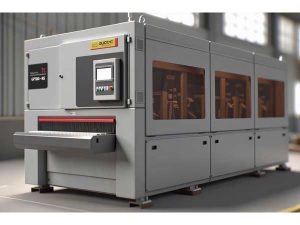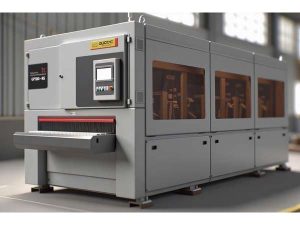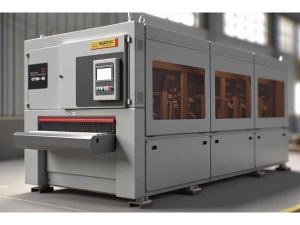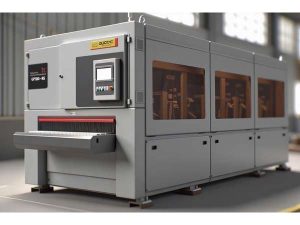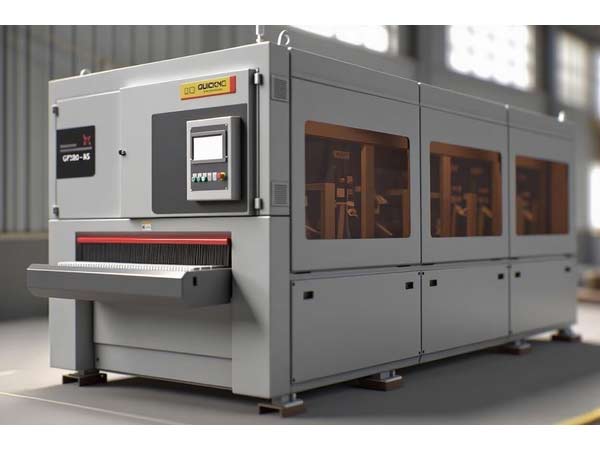

GP1300-A11 Flexible Irregular Sanding Machine
※ One sided sanding and polishing, saving time, improving production efficiency, and saving labor costs
※ Variable frequency speed regulation, simple and convenient
※ Modular design, can be combined with any sanding method to meet various sanding and polishing needs
Contact Us for Pricing
Interested in this product? Contact us now for detailed pricing and product information.
Product Details
Compact 11-Station Profile Sanding for Mid-Volume Woodworking Production
The GP1300-A11 Flexible Irregular Sanding Machine is the mid-sized workhorse of QUICKMO’s flexible sanding family. Sharing the same proven platform as our flagship 12-station model, the A11 packs 11 independently controlled sanding stations into a more compact footprint — purpose-built for furniture factories, door shops and panel processors that need true contour-following sanding without the investment of a full 12-head configuration. Built in Qingdao by Qingdao Kuaimo Technology Co., Ltd., the A11 delivers one-pass one-side sanding on shaped, curved, routed and profiled workpieces that ordinary wide-belt machines simply cannot handle.
The Sanding Challenge No Flat Belt Can Solve
Modern woodworking is no longer just flat panels. Raised cabinet doors, arched frames, table legs, chair components, decorative moldings, routed grooves and 3D relief work all need sanding — and they all share one problem: a rigid wide belt or flat steel roller cannot follow the shape. Left to hand sanding, the result is slow output, high labor cost, uneven scratches and obvious quality differences between operators.
The GP1300-A11 rethinks the problem. Instead of forcing the part against a rigid roller, it uses flexible sanding elements — brush rollers, eccentric sanding pads and oscillating bobbin sleeves — that actively wrap around the workpiece. Whether the panel is flat, profiled, curved or carved, each station bends to match, abrading every visible surface in a single pass.
11 Stations, Modular and Reconfigurable
The “A11” designation refers to the 11 sanding stations arranged along the machine from feed end to discharge end. Each station is a modular, independently controlled unit:
- Stations 1–2 (feed side): typically configured with aggressive brush or drum elements for initial stock removal and glue-line leveling.
- Stations 3–7: intermediate sanding groups, fitted with a mix of disc sanders and brush rollers that blend out scratches and reach into vertical edges and routed profiles.
- Stations 8–11 (discharge side): fine-sanding and polishing stations, using soft pads and non-woven brushes to deliver a paint-ready or veneer-ready finish.
Because the platform is modular, customers and our engineers together configure each machine around the parts they actually produce. Rough sanding, cross-grain sanding, edge breaking, corner rounding and final polishing can be combined in whatever order the process demands. If your product mix changes next year, stations can be re-equipped — no need to buy a new machine.
Every Grinding Shaft Is Independently Controlled
What makes the GP1300-A11 a Profile Sanding Machine worthy of serious production use is not the number of heads, but how each head behaves:
- Independent lifting. Every group of grinding axes can be raised or lowered on its own. Set high for thick slabs, set low for thin veneers — each station only contacts the surface it is meant to sand. This prevents over-sanding on delicate edges and under-sanding on flat faces.
- Independent speed adjustment. Each grinding shaft’s RPM is set digitally. Coarse stations run fast for aggressive removal; fine stations run slower to avoid heat build-up on UV-coated, PU-painted or heat-sensitive surfaces.
- Effective grinding-force control. Combined lift and speed control means the machine delivers consistent pressure across the whole profile — the single most important factor in producing scratch-free, uniform surfaces.
Operators set these values on the HMI and save them as recipes for future product runs. Changeover between jobs takes minutes.
One-Pass One-Side Sanding: Real Productivity Gains
The A11 sands and polishes one side of the workpiece in a single pass through the machine. No flipping, no re-fixturing, no second setup. For a typical production cell, this translates into:
- Higher throughput. Feed speed is VFD-adjustable, so the line runs fast enough for daily output yet gentle enough for fine finishing.
- Lower labor cost. One operator loads and unloads while the machine does the contour work that previously required a small team of hand sanders.
- Consistent quality. Because the machine repeats the same pressure and speed every cycle, the finished part looks the same on Monday morning as it does on Friday afternoon.
Variable-frequency feed drive keeps belt speed steady, and the conveyor bed lowers automatically in fault conditions — low air pressure, belt misalignment or e-stop — protecting both the workpiece and the operator.
Built for Real Woodworking Shops
The GP1300-A11 accepts panels up to 1300 mm wide. It is equally at home processing:
- Raised-panel and arched cabinet doors, where brush stations follow door profiles and pad stations smooth flat centers.
- Solid wood and engineered flooring, sanding faces, edges and end-grain in one pass.
- MDF and veneered panels for paint-grade finishing, including light de-nibbing between coats.
- Curved furniture components, chair backs, table tops and bedroom furniture parts.
- 3D carved and relief work, where flexible brushes clean out grooves and recesses that rigid belts cannot reach.
The welded steel frame is heavily ribbed to damp vibration, keeping scratch patterns clean even during long production runs. Pneumatic arms are precision-guided for repeatable positioning, and all major components are sourced from reputable suppliers for long service life.
Why the A11 Is the Smart “Step-Up” Choice
Potential buyers often compare the A11 with the larger A12. The difference is straightforward:
- The A12 adds one extra station at the discharge end for customers running extremely high-volume production or requiring multi-stage fine polishing.
- The A11 covers the same range of contoured sanding tasks with 11 stations, in a shorter footprint and at a more approachable investment level.
For the majority of furniture, door and panel shops, the A11 is the sweet spot: enough stations to handle real production sequences, without paying for capacity they will never use.
Brush Sanding That Reaches Where Belts Cannot
The Brush Sanding Machine capability is where the A11 truly earns its keep. Powered brush stations use abrasive filaments chosen for the application — stiff filaments for heavy shaping, soft filaments for fine finishing — and conform to every curve, corner and recess. This is why customers report the A11 replaces not just wide-belt sanding, but a surprising amount of manual edge-breaking and corner rounding that used to be done by hand.
Brush stations also break sharp edges after machining, remove cutter marks from CNC routing, and produce the subtly rounded edges that modern door and furniture styles demand.
Customization and Global Support
Every GP1300-A11 can be tailored to your specific workflow. QUICKMO’s engineering team works with customers to select the right mix of drum, disc, brush and pad stations, to match your workpiece sizes and your finish-quality targets. Special configurations for narrow stock, thin panels or heavy removal are available, and the machine can be integrated into an existing production line with infeed and outfeed rollers.
QUICKMO exports to woodworking markets worldwide, supports customers with documentation, spare parts and remote commissioning guidance, and stands behind every machine with the same “quality first, service first” philosophy that has built our reputation over more than a decade.
Choose the GP1300-A11 for Your Contoured Sanding Needs
If your shop is still hand-sanding profiled parts, or running a wide-belt machine that leaves curved surfaces unfinished, the GP1300-A11 Woodworking Sanding Equipment upgrade is the fastest path to consistent, automated, one-pass contour sanding. It turns irregular surfaces from a labor bottleneck into a standard, repeatable production step.
Send us your sample workpieces or drawings today, and our engineers will recommend the exact 11-station configuration for your product mix.