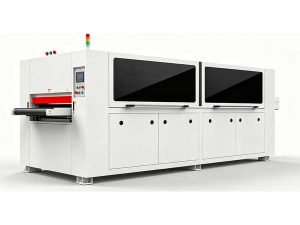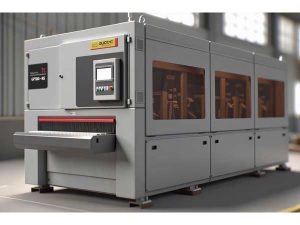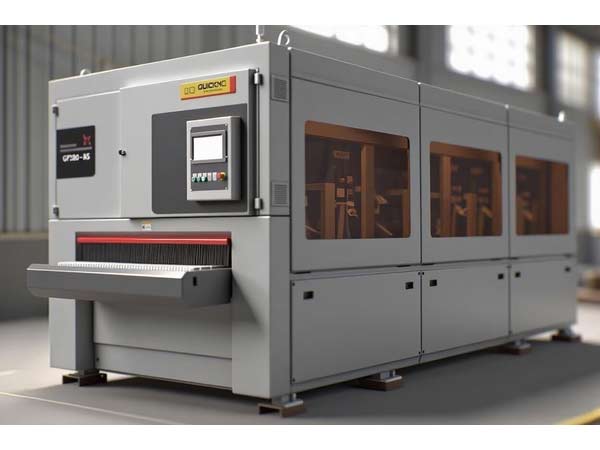

GP1300-A12 Flexible Irregular Sanding Machine
Precision Sanding for Complex Profiles, Curved Surfaces and Irregular Workpieces
Contact Us for Pricing
Interested in this product? Contact us now for detailed pricing and product information.
Product Details
Precision Sanding for Complex Profiles, Curved Surfaces and Irregular Workpieces
The GP1300-A12 Flexible Irregular Sanding Machine is a flagship model from QUICKMO’s flexible sanding series, engineered to solve one of the most stubborn problems in woodworking finishing: how to sand shaped, contoured and irregular surfaces evenly, efficiently and repeatably — without relying on hand sanding. Designed and manufactured by Qingdao Kuaimo Technology Co., Ltd. at our modern facility in Jimo, Qingdao, this machine combines 12 independently controlled sanding stations in a single pass, delivering factory-grade finishing quality across solid wood panels, MDF, plywood, curved door components, moldings and 3D carved workpieces.
Why Standard Wide-Belt Sanders Fall Short
Conventional wide-belt sanders are built for flat panels. When the workpiece has arched edges, routed profiles, raised relief, routed grooves or curved surfaces, a flat steel roller simply cannot follow the contour. Operators are forced to hand-sand, use random-orbit pneumatic sanders, or accept inconsistent quality — a process that is slow, labor-intensive and prone to human error.
The Flexible Irregular Sanding Machine takes a completely different approach. Instead of forcing the workpiece against a rigid roller, it uses flexible, contour-flying sanding heads — brush rollers, eccentric sanding pads and bobbin sleeves — that actively bend to match the shape of the part. The result is uniform abrasion across every surface, edge and curve in a single automatic pass.
12 Independent Sanding Stations, Fully Modular
The GP1300-A12 is built around a 12-station sanding bridge, arranged from feed end to discharge end. Each station can be equipped with the sanding element best suited to that stage of the process — heavy drum, disc sander, brush roller or polishing pad — and configured independently for height, pressure and speed.
Modular Sanding Solution means you are not locked into a fixed setup. Customers configure the GP1300-A12 to match their own production line:
- Rough sanding stations remove stock and level surface imperfections.
- Intermediate stations blend sanding marks and smooth out tooling chatter.
- Brush rollers reach into routed profiles, carved grooves and vertical edges that flat belts cannot touch.
- Final polishing pads deliver a ready-for-coating finish on paint-grade, veneer and solid-wood surfaces.
Because every grinding shaft can be lifted, lowered and speed-adjusted independently, operators can dial in the exact aggressiveness required — from aggressive stock removal on raw slabs to ultra-fine polishing on UV-coated panels — without re-tooling the machine.
Single-Pass One-Side Sanding: Faster, Leaner, More Consistent
One of the most immediate benefits customers notice is cycle time. The GP1300-A12 completes one-sided sanding and polishing in a single pass through the machine. There is no flipping, no re-fixturing and no second pass. For a typical door or furniture panel, this means:
- Higher throughput per shift, with a feed speed adjustable from gentle finishing to production-rate removal.
- Direct labor savings, because one operator can now run jobs that previously required two or three hand sanders.
- Consistent quality shift after shift, because the machine applies the same pressure and speed every time, removing the variability introduced by hand sanding.
Variable-frequency feed drive means the conveyor speed is set on the HMI and held constant — slow enough for aggressive stock removal, fast enough for light finishing — and every workpiece in the batch comes out identical.
Independent Grinding Shaft Control: Quality You Can Dial In
What truly separates the GP1300-A12 from basic profile sanders is how each grinding group is managed:
- Independent lift control. Every group of grinding axes can be raised or lowered individually. This lets the operator tailor sanding pressure to each workpiece thickness and profile depth, so delicate edges are not over-sanded while flat faces receive full abrasion.
- Independent speed control. Each grinding shaft’s rotational speed is adjustable on its own. Coarse grit runs fast for stock removal; fine grit runs slower to avoid burn-through on heat-sensitive veneers and paints.
- Effective grinding-force management. By pairing lift and speed control, the machine holds a constant and predictable grinding force across the whole surface — the key to scratch-free, uniform finishing.
These controls are not theoretical. They are the reason the GP1300-A12 handles everything from solid wood joinery to lacquer-sanding on painted MDF, without changing the machine.
Built for a Wide Range of Woodworking Applications
The Wood Sanding Machine category is broad, and the GP1300-A12 is purpose-built for the demanding end of it. Typical production use includes:
- Cabinet and door shops: sanding raised-panel doors, arched doors, profiled frames and inset panels.
- Furniture manufacturers: finishing table tops, chair parts, bed frames and shaped components before assembly.
- Flooring and moldings: sanding skirting, architrave, engineered flooring and decorative profile strips.
- Veneer and panel processing: smoothing veneer joints, removing glue squeeze-out and preparing surfaces for lamination.
- 3D carved and relief work: brush-based stations clean out carved grooves and raised relief that flat belts cannot reach.
The machine accepts panels up to 1300 mm wide (the “1300” in GP1300-A12), making it suitable for most standard door, furniture and panel widths.
Robust Frame, Safe Operation, Long Service Life
QUICKMO builds the GP1300-A12 on a heavy, welded-steel frame that dampens vibration during high-force sanding. The conveyor bed is constructed to remain flat and true over years of daily use, and the pneumatic sanding arms are engineered for repeatable positioning. Safety features include automatic conveyor lowering in fault conditions (low air pressure, belt misalignment or emergency stop), protecting both the workpiece and the operator.
The human-machine interface is straightforward: feed speed, each station’s height, and each station’s speed are all set digitally. Setup between product runs takes minutes, not hours — a critical advantage for low-batch, high-variety woodshops.
Custom Configurations Available
Because every workshop has different workpieces, QUICKMO offers the GP1300 platform in multiple configurations — the A12 is our 12-station flagship, and shorter or differently arranged configurations (A11, M10, A9S, M9 and others in the series) are available to match narrower budgets or simpler product mixes. Our engineering team can also customize the machine around your specific profiles, workpiece sizes and production-line layout, transforming your concept into a working production cell.
Choose QUICKMO for Your Profile Sander Investment
A Profile Sander is a long-term production asset, and the GP1300-A12 is engineered to protect that investment. Backed by QUICKMO’s team of woodworking-machinery engineers in Qingdao, the machine is built from high-quality components, supported by accessible spare parts, and shipped worldwide with commissioning guidance and operator training.
Whether you are replacing hand sanding, upgrading an aging wide-belt line, or expanding capacity into profiled and curved work, the GP1300-A12 Flexible Irregular Sanding Machine delivers the sanding consistency, throughput and labor savings that modern woodworking production demands.
Contact QUICKMO today with your sample workpieces or drawings, and our engineers will recommend the exact station configuration for your product mix.