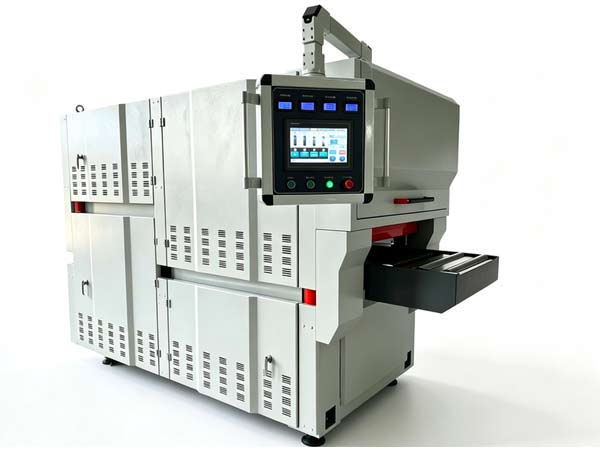
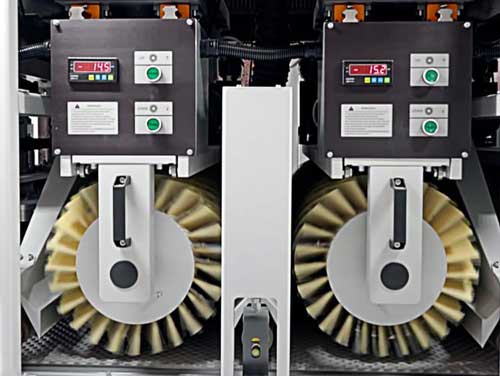
Traditional wood-panel processing usually completes one-side sanding first, then workers flip each panel manually for reverse-side sanding. This manual-flipping workflow consumes abundant labor time, introduces human-caused positioning error and restricts production-line speed. The Double–Sided Thickness Finishing Sanding Machine changes this mode: realizing simultaneous top–bottom sanding in one single workpiece feeding pass, which greatly optimizes panel-processing workflow for furniture and cabinet factories.
This machine arranges sanding groups both above and under the conveying track. When panels pass through the machine cavity, top-side and bottom-side get calibrated and polished synchronously. It eliminates manual flipping operation completely. For mass-production of MDF solid–wood composite panel, the value of one-pass processing is prominent. Production throughput rises while labor-related cost and handling-caused panel damage rate drop significantly.
Precision control is the core evaluation index for double-sided sanding equipment. Good-quality double-sided sanders can maintain consistent thickness tolerance for both surfaces. If machine frame rigidity is insufficient, upper-sand-frame vibration will interfere lower-side processing precision and result in uneven thickness on two sides. Heavy-duty welded-profile frame structure is indispensable to guarantee long-term stable dual-side sanding accuracy. Variable-frequency feeding-speed adjustment adapts for diverse-material characteristics: hardwood, soft-wood, MDF and composite panels all can obtain proper processing parameters.
Many buyers have questions about applicable-scope limitation of double-sided sanding machines. This equipment suits flat-format panel-type work-pieces including solid-wood boards, density-boards, plywood and composite panels. It is excellent for pre-painting thickness calibration. But it is not designed for irregular curved-shape components; for contoured furniture-parts, users still need to match flexible irregular sanding machines. It is necessary to reasonably combine different sanding-device types to build complete workshop processing capability.
During procurement, factory managers need to clarify their actual workpiece-size range. Confirm effective processing width, minimum-maximum work-piece thickness and minimum-processable-part length. Some low-grade double-sided sanders cannot handle short narrow work-pieces reliably, leading to frequent workpiece-jamming faults. Kuaimo Tech’s 630R-R+R-RP double-sided thickness finishing sanding machine realizes one–pass wood processing for flat panels, widely applied in cabinet-board, door-panel and decorative-material manufacturing factories.
For enterprises pursuing higher automation level, double-sided sanding machines can connect with front-end planing equipment and rear-end primer-sanding machines, constructing fully-automatic panel-processing production-line. As labor-cost keeps increasing globally, synchronous double-sided sanding solution gradually becomes popular configuration for new-built modern wood-working workshops.
CTA: Contact Kuaimo Tech to get configuration suggestion whether double-sided sanding solution fits your production-line upgrade plan.