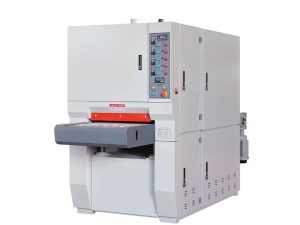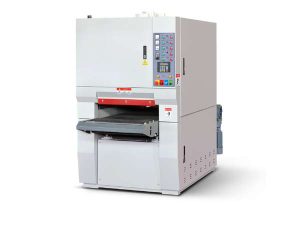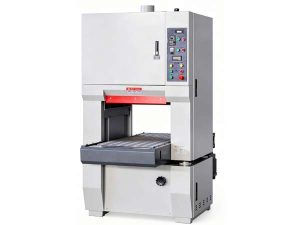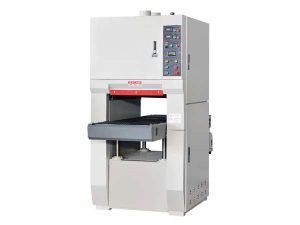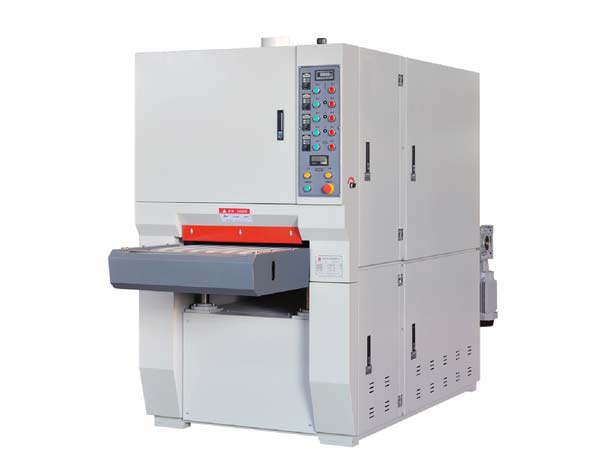


1300-BS Upper Floated Planer Sanding Machine
It is designed specifically for raw boards with significant surface irregularities, such as solid wood panels and composite materials, as well as those with prominent seams; it enables large-scale planing operations. It combines planing and sanding functions, as well as thickness adjustment and fine polishing in one unit. The planing knives are spiral-shaped, and the cutting blades are rectangular and heavy-duty, allowing for large amounts of material to be planed efficiently. It features a segmented pressing mechanism and a feed belt with anti-rebound features, which helps to save electricity and sanding belts while improving production efficiency.
Contact Us for Pricing
Interested in this product? Contact us now for detailed pricing and product information.
Product Details
Combined Planing and Sanding: One Machine for Rough Solid Wood Panels with High Seams
The 1300-BS Upper Floated Planer Sanding Machine is QUICKMO’s combined planer-sander, engineered specifically for raw solid wood panels and edge-glued boards with significant surface irregularities and prominent glue seams. Manufactured by Qingdao Kuaimo Technology Co., Ltd. in Qingdao, China, the 1300-BS pairs a heavy-duty spiral cutterhead with a sanding station, so rough panels that would normally require both a planer and a sander can be processed in a single pass — planed, thickness-calibrated and fine-polished all at once.
The Problem: Rough Panels That Need Both Planing and Sanding
Solid wood edge-glued panels, laminated beams and composite wood stock arrive from the press with a problem: the surface is not flat. Glue seams are raised, the panel is cupped, planer marks are visible, and there is significant thickness variation across the board. A standard wide-belt sander can sand the surface smooth, but it cannot remove enough stock to flatten a rough, high-seam panel — it would wear through abrasive belts in minutes and still leave the seam marks.
A planer can flatten the panel, but it leaves planer marks that then need sanding. So shops run the panel through a planer, then through a sander — two machines, two operators, two setups.
The 1300-BS combines both steps.
How the 1300-BS Works
The machine arranges a heavy planing station followed by a sanding station along the same conveyor:
- Planing station (infeed): a spiral cutterhead with heavy-duty rectangular indexable blades removes large amounts of stock in a single pass, flattening the panel and cutting through high glue seams.
- Sanding station (discharge): a sanding belt follows immediately, smoothing out the planer marks and bringing the panel to a fine, uniform surface.
The panel goes in rough and uneven, and comes out flat, calibrated and sanded — one pass, one machine.
Spiral Cutterhead with Heavy-Duty Indexable Blades
The planing head is the heart of the 1300-BS:
- Spiral-shaped cutterhead. The blades are arranged helically around the head, cutting in a shearing action rather than a straight knife cut. This produces a smoother surface, reduces noise, and extends blade life.
- Rectangular heavy-duty indexable blades. Each blade is a small, reversible carbide insert that can be rotated to a fresh edge when one side dulls. This is far more efficient than grinding or replacing full planer knives.
- Large planing volume. The spiral head removes significant stock per pass — enough to flatten rough panels, level high seams and correct cupping — without the need for multiple planer passes.
Segmented Presser Feet and Anti-Rebound Feed
The 1300-BS is engineered around two practical features that protect both the workpiece and the operator:
- Segmented presser foot design. Instead of a single flat pressure bar, the machine uses segmented presser feet that follow the panel surface. This holds uneven panels flat against the conveyor without bruising or over-compressing high spots.
- Anti-rebound feed belt. The feed belt is designed to prevent workpiece kickback. When a rough panel with a high seam hits the planing head, the anti-rebound belt keeps the panel pulled through rather than allowing it to kick back.
Together, these features make the machine safer and more reliable on rough, uneven stock.
Why the 1300-BS Saves Money
The 1300-BS is not just a space-saver — it is a cost-saver:
- Saves electricity. By combining planing and sanding in one pass, the machine runs once instead of twice, cutting energy consumption per panel roughly in half.
- Saves sanding belts. Because the spiral cutterhead removes most of the stock, the sanding belt only has to smooth planer marks — not flatten a rough panel. Belt life is dramatically extended.
- Improves production efficiency. One operator, one pass, one setup. Panels move from rough stock to sanded and ready in a single operation.
What the 1300-BS Handles
The 1300-BS is engineered for rough solid wood panels and composite boards:
- Solid wood edge-glued panels and glued-up boards, flattening surfaces and leveling glue seams.
- Solid wood composite materials and laminated beams, removing stock to uniform thickness.
- Rough-sawn panels with significant surface irregularities, planed smooth in one pass.
- Thick slabs and dimensioned stock that need both planing and sanding.
It is not a finishing sander for already-smooth panels; it is the machine that handles the rough, high-seam panels that normal sanders cannot.
Who Is the 1300-BS For?
The 1300-BS is the right choice when:
- You process solid wood edge-glued panels, laminated beams or rough-sawn stock.
- Your panels arrive with high glue seams, surface unevenness or cupping.
- You currently run panels through a planer and then a sander, and want to combine those steps.
- You want to reduce abrasive belt wear and energy consumption per panel.
- You need a machine that removes large amounts of stock while still delivering a sanded finish.
Shops processing already-smooth MDF, plywood or veneered panels should use the standard 1300R-RP calibrating sander; shops needing double-side calibration should look at the WKXS line. For rough solid wood panels that need both planing and sanding, the 1300-BS is the purpose-built tool.
Why Choose QUICKMO
Qingdao Kuaimo Technology Co., Ltd. has spent more than a decade designing and building woodworking sanding and planing equipment from our Qingdao facility. We integrate design, manufacturing and in-house engineering, which means customers deal directly with the people who build the machine — no dealer layers, no ambiguity about support. We ship worldwide, provide documentation and remote commissioning guidance, and stand behind every machine with a “quality first, service first” commitment.
The 1300-BS Upper Floated Planer Sanding Machine is the combined answer to rough solid wood panel processing: a spiral-cutterhead planer followed by a sander, flattening high seams and delivering a sanded finish in a single pass.
Ready to Talk About Your Project?
If your shop is running rough edge-glued panels through a planer and then a sander, the 1300-BS is built for exactly that work.
Contact QUICKMO today with your panel sizes, typical seam height and production volume, and our engineers will confirm whether the 1300-BS covers your range.